The Rosetta Stone carries a decree issued in 196 BCE by Egyptian priests to praise the young king Ptolemy V and establish religious honours in his name. It contains neither a prophecy nor a lost secret. Its importance comes from presenting the message in two languages and three scripts, providing the comparisons that eventually made Egyptian hieroglyphs readable again.
A political decree, not a mysterious message
A council of priests meeting at Memphis approved the inscription during the ninth year of Ptolemy V Epiphanes. The king belonged to the Macedonian dynasty that ruled Egypt following the conquests of Alexander the Great.
Ptolemy had inherited the throne as a child and was around 13 when the decree was issued, on the first anniversary of his coronation. His kingdom faced internal rebellion, military pressure and economic disruption. The document belongs to this political setting: it presents the young monarch as Egypt’s legitimate and effective protector.
The decree lists benefits supposedly provided by Ptolemy. It says that he gave money and grain to temples, reduced or cancelled certain taxes and debts, freed some prisoners, protected priestly revenues, restored sanctuaries and supported the cults and burials of sacred animals.
In return, the priests agreed to expand the royal cult. Images of Ptolemy V were to be installed in temples, ceremonies performed before them and festivals held on dates associated with his birth and accession. The stone therefore records an exchange of support between the monarchy and the priesthood.
A translation of the Greek section provided through Fordham University sets out these concessions, praises and ritual instructions in detail.
What it says in modern terms
The essential message can be summarised as follows:
- Ptolemy V has benefited the temples, priests and people of Egypt.
- He has reduced certain financial burdens, restored religious property and defended the country.
- He has defeated his opponents and deserves recognition as Egypt’s protector.
- Temples must install statues and shrines honouring the king.
- Priests will perform ceremonies and celebrate festivals in his name.
- Copies of the decree must be carved in stone and displayed in major temples.
The surviving stone was therefore not a unique monument intended to preserve an exceptional revelation. It was one of several stelae used to distribute an official decision. The British Museum explains that other copies or fragments of the Memphis Decree have since been identified.
Two languages and three scripts
The stone is often said to contain three languages, but that is not quite correct. It carries two languages—Egyptian and Ancient Greek—written in three different scripts:
- Hieroglyphs occupy the upper section and were appropriate for a priestly decree displayed in a temple.
- Demotic appears in the middle. This cursive Egyptian script was used for many everyday, legal and administrative texts.
- Ancient Greek fills the lower section and reflects the language of government under the Ptolemaic dynasty.
The three versions are not exact, word-for-word translations. They communicate essentially the same decree but contain differences of expression suited to their distinct linguistic and cultural settings.
The final instruction explicitly orders copies to be engraved in “sacred”, “native” and Greek characters. The original purpose was to communicate with different groups in Ptolemaic Egypt, not to assist researchers living two thousand years later.
The surviving stone is only a fragment
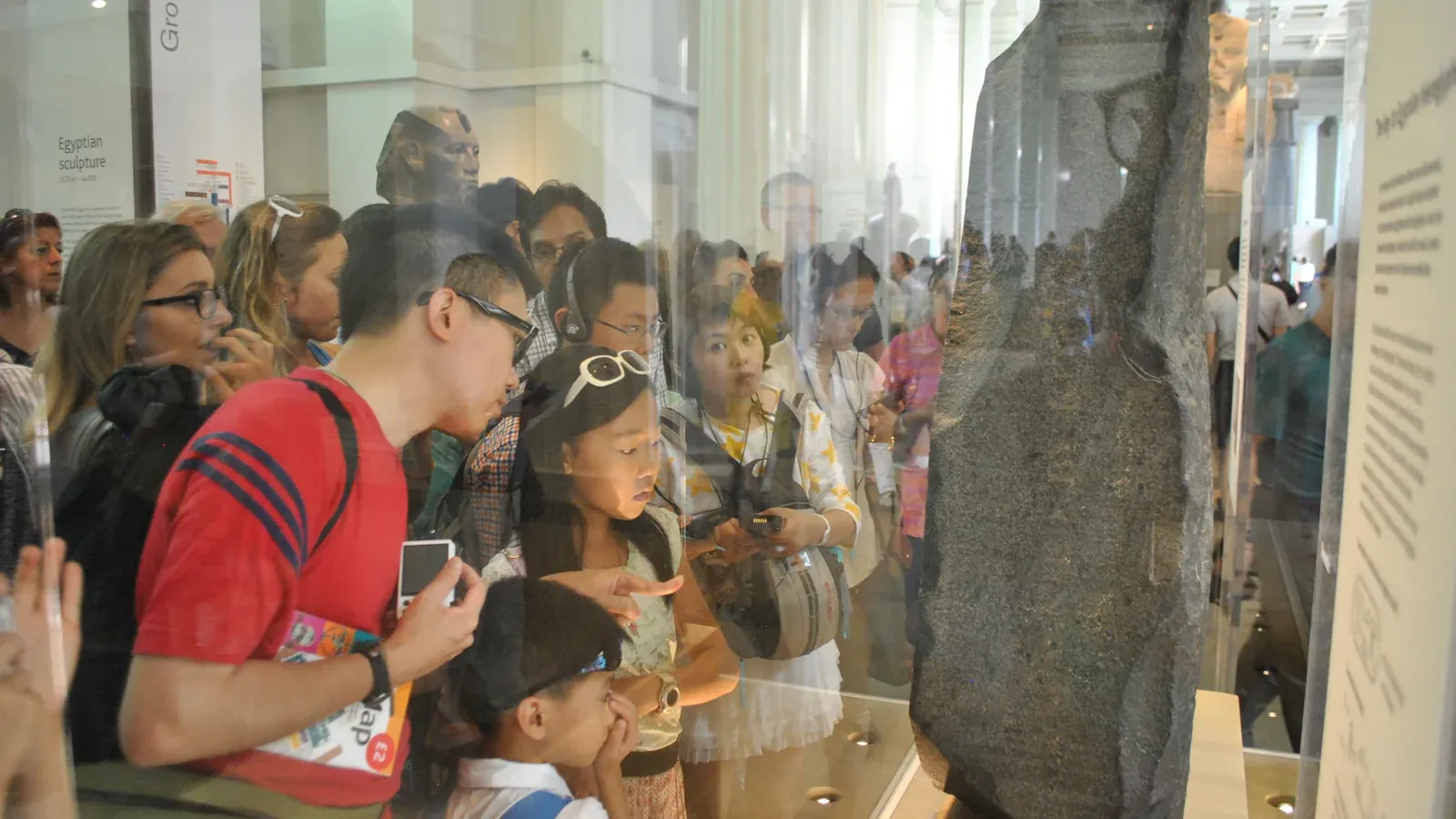
The object is approximately 112 centimetres high and made from granodiorite. Despite its familiar and apparently self-contained outline, it is merely the lower portion of a much larger stela.
The missing top probably ended in a rounded shape and included a scene showing the king before a group of deities. Large parts of the inscription are gone, especially from the hieroglyphic section. Fourteen lines of hieroglyphs, 32 of Demotic and 53 of Greek survive on the present fragment.
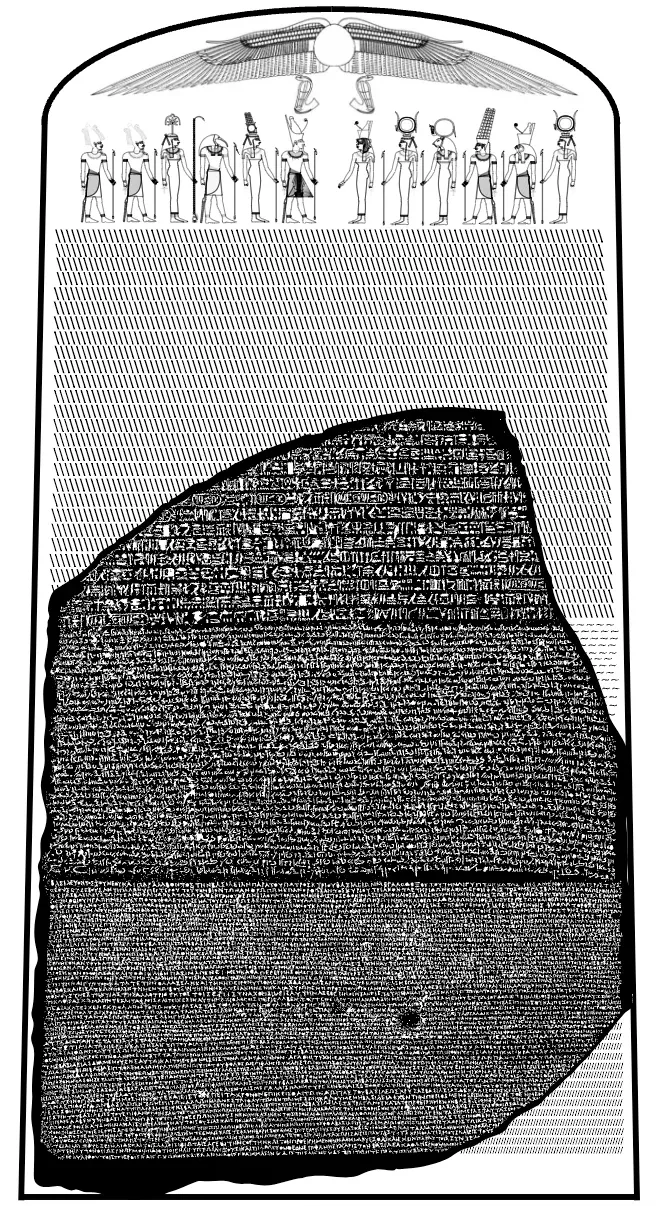
Image credits and licence
Its dark appearance has caused another persistent misunderstanding. The stone was long described as basalt, but analysis identified it as grey and pink granodiorite. Its polished surface and display conditions can make it look almost black.
Its rediscovery in 1799
The stela had been reused as building material near Rashid, the Nile Delta town known to Europeans as Rosetta. In July 1799, during the French campaign in Egypt, officer Pierre-François Bouchard recognised the potential importance of the inscriptions while construction work was taking place at Fort Julien.
French specialists quickly realised that the Greek passage might offer a route into the two Egyptian sections. Copies of the inscriptions were produced and circulated among scholars across Europe.
After the French defeat, the stone was transferred to British possession under the 1801 Capitulation of Alexandria. It entered the British Museum in 1802 and remains there today. This journey was not a neutral archaeological transfer: it was directly connected with military and imperial rivalry between France and Britain on Egyptian territory.
Why Greek supplied a decisive clue
European scholars in the early nineteenth century could read the Greek inscription, but the knowledge required to understand Demotic and hieroglyphic Egyptian had disappeared. Hieroglyphs had long been treated in Europe as almost exclusively symbolic pictures expressing whole ideas.
The Greek version revealed the general subject of the decree and supplied personal names, titles and repeated expressions that should also appear in the Egyptian sections. The name Ptolemy, enclosed in an oval frame now called a cartouche, became especially useful.
If a particular group of hieroglyphs represented Ptolemy, scholars could compare the signs with the letters and sounds of that known name. The stone functioned as a parallel text. It did not provide a ready-made dictionary, but it offered testable correspondences.
Decipherment was gradual and collaborative
The scripts were not solved immediately. Antoine-Isaac Silvestre de Sacy and Johan David Åkerblad made early progress with Demotic. British polymath Thomas Young established important relationships between the Egyptian scripts and correctly identified several phonetic signs in Ptolemy’s name.
The decisive advance came from Jean-François Champollion, who knew Coptic, the latest historical stage of the Egyptian language, written with an alphabet derived largely from Greek. By comparing the stone with other monuments and royal names, he recognised that hieroglyphs did not represent ideas alone.
The writing system combined several methods. Some signs represented sounds, some stood for complete words and others classified a word’s meaning without being pronounced. In 1822, Champollion presented principles that made it possible to begin reading this system consistently. The British Museum’s decipherment timeline demonstrates how his breakthrough depended on earlier contributions and additional inscriptions.
The stone did not decode hieroglyphs by itself
Calling the Rosetta Stone “the key” is reasonable, provided that we do not imagine an automatic translation. The monument was incomplete, its versions did not correspond word for word and hieroglyphic writing was far more complex than a conventional alphabet.
Understanding it required knowledge of Greek, Demotic, Coptic and Egyptian grammar, together with comparisons involving obelisks, papyri and other inscriptions. Young made essential discoveries, while Champollion explained the system’s broader operation and applied it beyond foreign royal names.
The stone supplied a reliable foundation against which hypotheses could be constructed and tested. Without that comparative evidence, separating the phonetic values of signs from their symbolic and semantic functions would have been much harder.
A doorway into thousands of years of history
Decipherment made it possible to read inscriptions in temples and tombs, administrative documents, private letters, literary works, religious compositions and records of everyday life. Carved figures ceased to be images observed only from outside and recovered their linguistic dimension.
Scholars could now reconstruct names, events, beliefs and historical changes across more than three thousand years with far greater precision. The Rosetta Stone matters not because its decree was unusually original—it was largely formulaic—but because of an extraordinary coincidence: enough known and unknown information survived together on a single object to build a bridge between them.