Perspective is the set of tools artists use to make a flat image suggest depth, distance, and volume. It changed painting because it made it possible to organise a coherent world within the picture: buildings, bodies, and landscapes could appear to occupy the same space, while lines could guide the viewer’s eye towards a crucial figure or idea.
It does not simply mean “making art look realistic,” nor does it only mean drawing roads that narrow into the distance. Perspective can be created with lines, colour, scale, overlap, or the way a body is seen from an angle. What made Renaissance linear perspective so consequential was that it turned some of these observations into a geometric system that could be planned and repeated.
A solution to an old problem
A painting has height and width, but no physical depth. Yet we perceive depth because our eyes and brains interpret clues: an object partly covering another one appears closer; distant things tend to look smaller; and a straight road seems to narrow as it moves away from us.
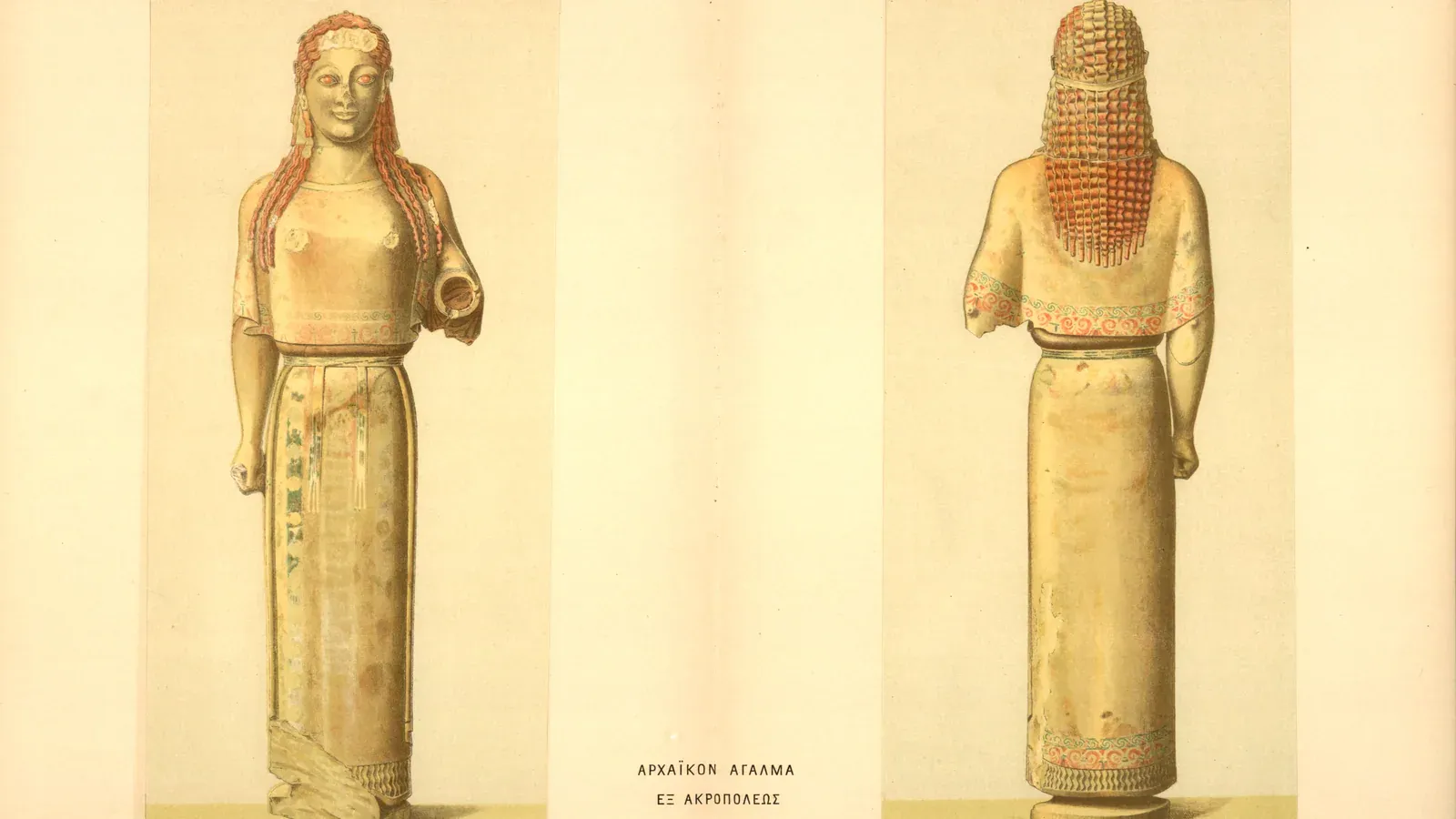
Artists had used many such clues long before the Renaissance. They could overlap figures, reduce their scale, or place them higher in a composition. But those choices did not always aim to build one measurable, unified space. In many medieval European images, for instance, a figure’s size could express spiritual or narrative importance before it indicated physical distance.
Renaissance perspective did not erase these older possibilities. It added another one: treating the picture as a scene viewed from a particular position. That made it possible for architecture, tiled floors, and groups of people to share a convincing visual scale.
Linear perspective: lines that seem to meet
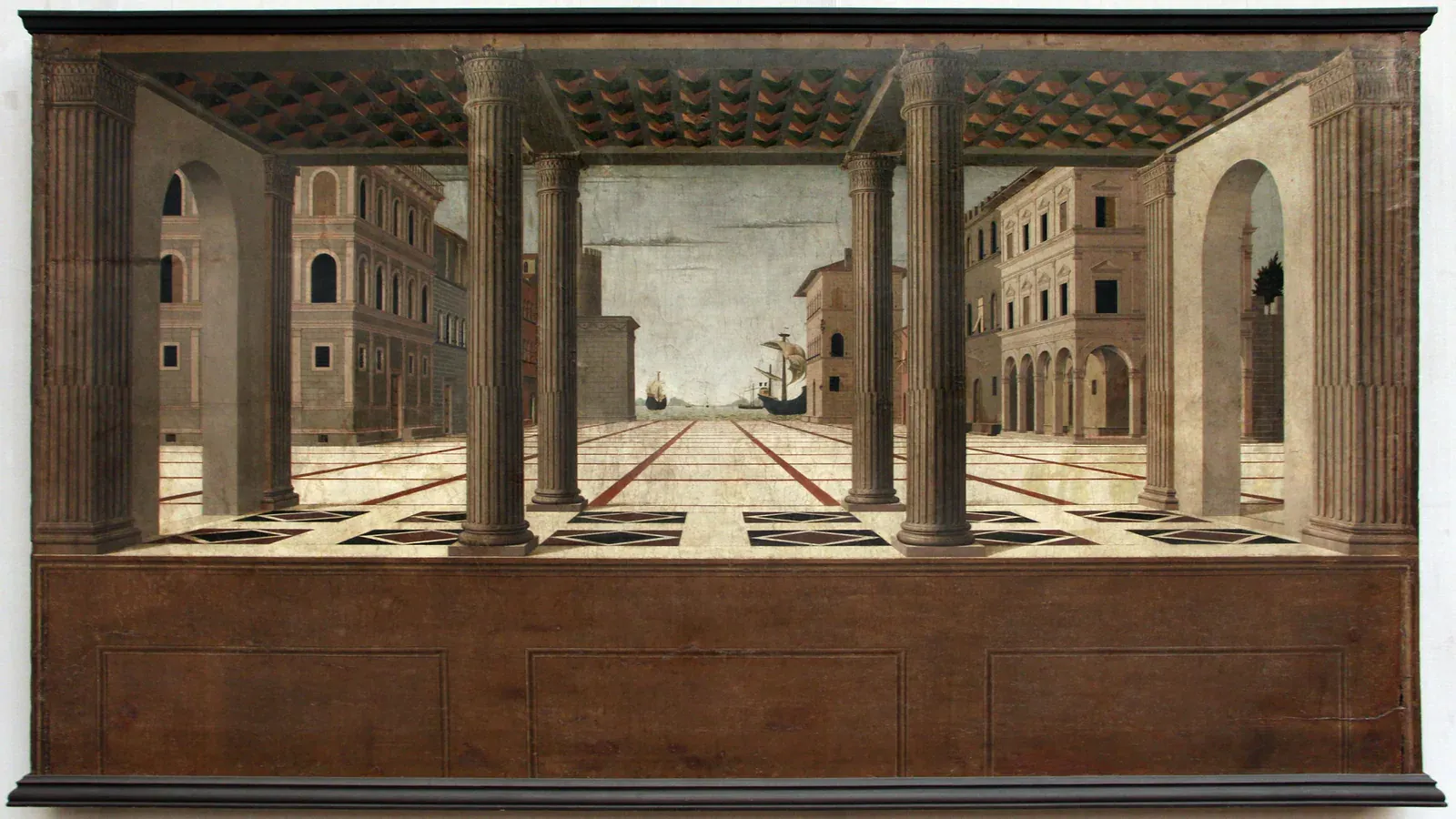
Linear perspective arranges pictorial space around a simple optical principle. When we look along a straight road, its parallel edges seem to draw closer together as they recede. In a painting, the lines that represent those directions—along a floor, roof, or colonnade—are often called orthogonals. They appear to meet at a vanishing point.
That point normally lies on the horizon line, roughly corresponding to the viewer’s eye level. It does not mean that parallel lines truly meet in the world. It describes how their projection behaves on a surface viewed from a fixed position.
The National Gallery in London draws a useful distinction: linear perspective relies chiefly on line, while aerial perspective relies primarily on tone and colour. In the single-point system described by Leon Battista Alberti, parallel lines that recede appear to converge at one point on the horizon. National Gallery, London
Imagine a tiled square. When the tiles become progressively smaller and their edges point towards a shared destination, the viewer can feel the ground continuing into the image. Geometry is not merely hidden scaffolding; it is what makes distance readable.
Foreshortening and aerial perspective
Linear perspective is only one part of the story. Foreshortening makes an object or body seem to project backwards or forwards in space by representing it as visually shortened. An arm reaching towards the viewer is not painted at its full physical length: it is compressed on the picture plane so that it can seem to occupy depth.
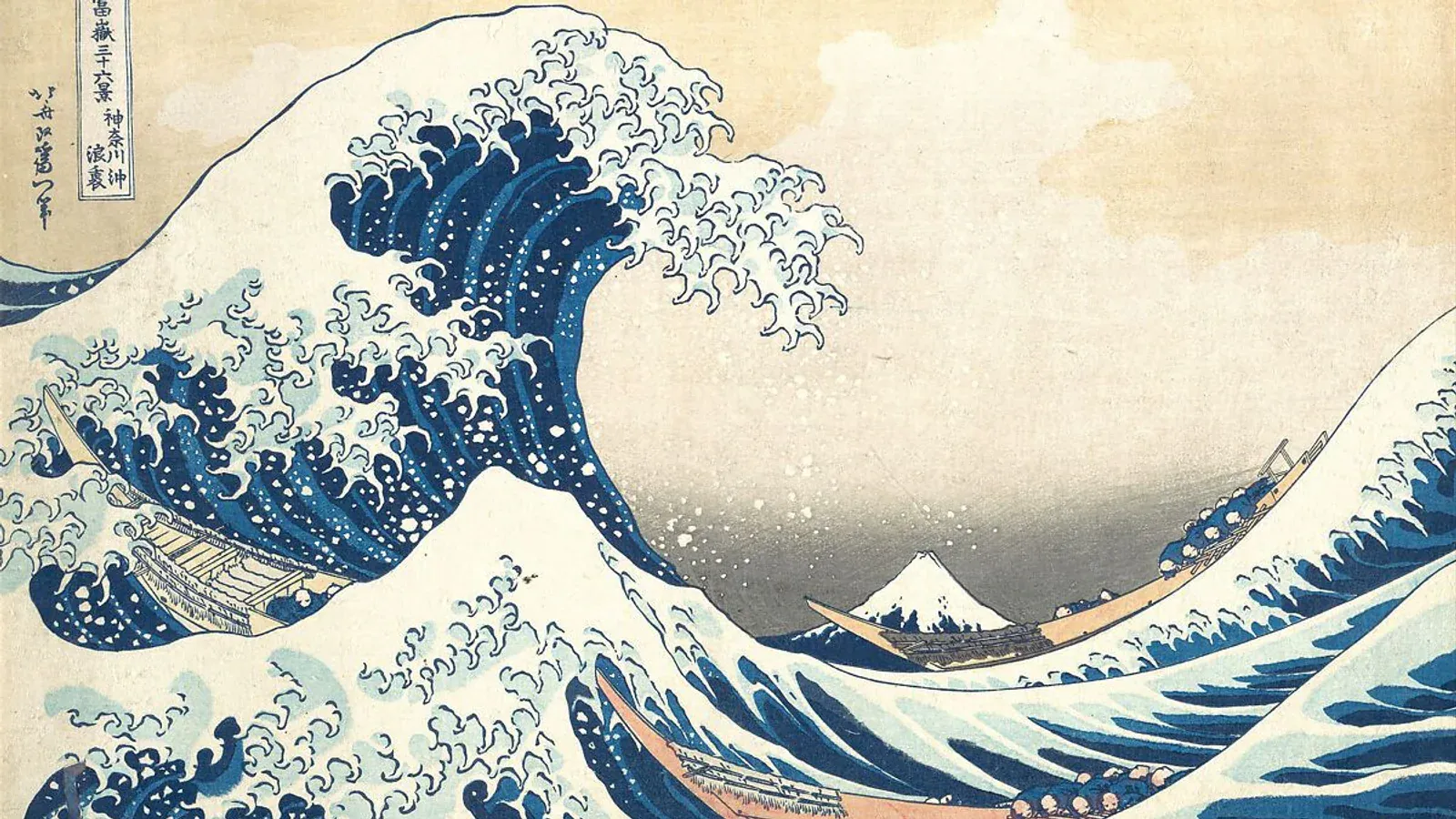
Aerial, or atmospheric, perspective solves a different problem. Even without a grid of lines, air changes the way distance looks. Faraway mountains commonly lose contrast, turn cooler or bluer, and reveal less detail. Leonardo observed this effect, and painters learned to recreate it through gradual changes in colour and tone. National Gallery, London
A painting can therefore combine a street with a vanishing point, a foreshortened figure, and blue hills in the distance. Its sense of space comes from the cooperation of these devices, not from a single formula.
Florence: from experiment to method
In the early fifteenth century, Filippo Brunelleschi developed systems of linear perspective and proportion in Florence. The Metropolitan Museum of Art notes that he demonstrated them in two experimental panels, now lost, depicting the Palazzo della Signoria and Florence’s Baptistery. The Metropolitan Museum of Art
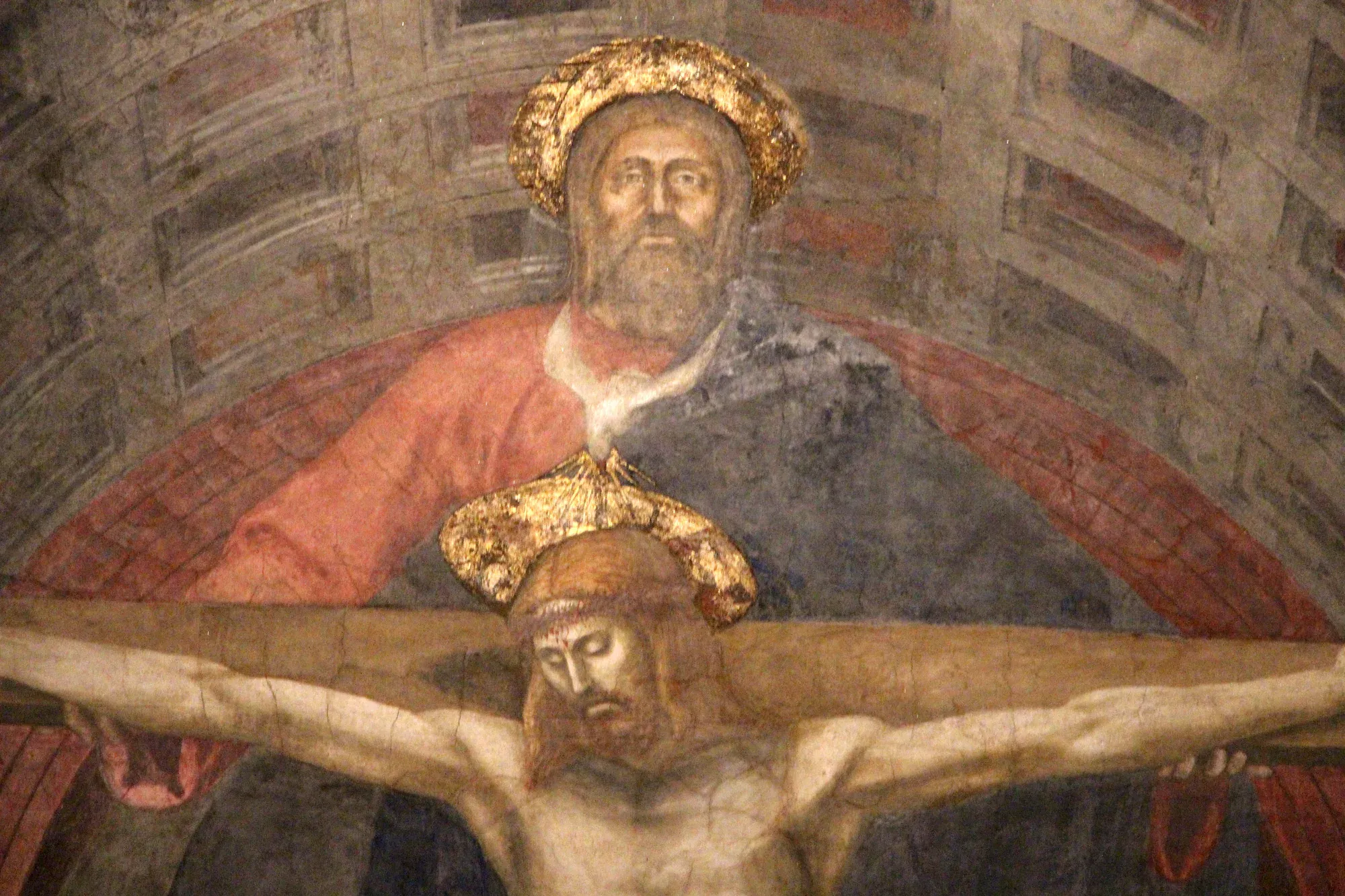
The essential advance was not discovering that distance changes appearances. It was developing a way to predict those changes through rules. Soon afterwards, Masaccio applied the principles in The Trinity at Santa Maria Novella. Its painted architecture seems to open a chapel inside the wall and extend the viewer’s own space. The National Gallery of Art describes the effect as making the wall appear to disappear, so that the painting becomes an extension of the room. National Gallery of Art
In 1435, Alberti wrote De pictura in Latin; its Italian version, Della pittura, followed the next year. His treatise offered an influential theoretical formulation of perspective and helped promote its use among Renaissance painters. National Gallery, London
Why it changed painting
The first change was spatial. Painting could offer interiors where people appeared to stand at different distances, streets with a clear path through them, and buildings whose scale felt immediately intelligible. A scene was no longer only an arrangement of figures across a surface; it could become a place.
The second change was narrative. A vanishing point does more than organise tiles and columns: it directs attention. In Renaissance works, its location can reinforce the dramatic or symbolic centre of a story. Technical research from the National Gallery shows that vanishing points could be positioned deliberately to focus attention on a meaningful feature, while perspectival structure could support narratives of figures moving through a scene. National Gallery, London
The third change was intellectual and practical. Painting came to involve more explicit calculation, measurement, and planning. In some works, the geometric pavement was drawn before the architecture and figures. This did not turn artists into mere technicians. It gave them a precise tool for deciding where the viewer stands, how far characters are from one another, and where visual tension should accumulate.
Not a neutral window onto the world
Linear perspective was profoundly influential, but it is neither the only valid way to represent space nor an automatic copy of human vision. It depends on a stable viewpoint, as though the viewer were looking with one unmoving eye from one fixed place. Actual vision is more mobile: we turn our heads, focus on different areas, and build an understanding of a place over time.
That is why artists have used, adapted, and rejected perspective according to their aims. A painting may abandon geometric consistency in order to emphasise a figure, express movement, bring several moments of a story together, or create a space that is more emotional than optical.
Perspective’s great achievement was not forcing every painting to resemble a photograph. It was showing that space could be constructed. Since then, a line receding towards the horizon can be a geometric rule, a route for the eye, and a narrative decision all at once.