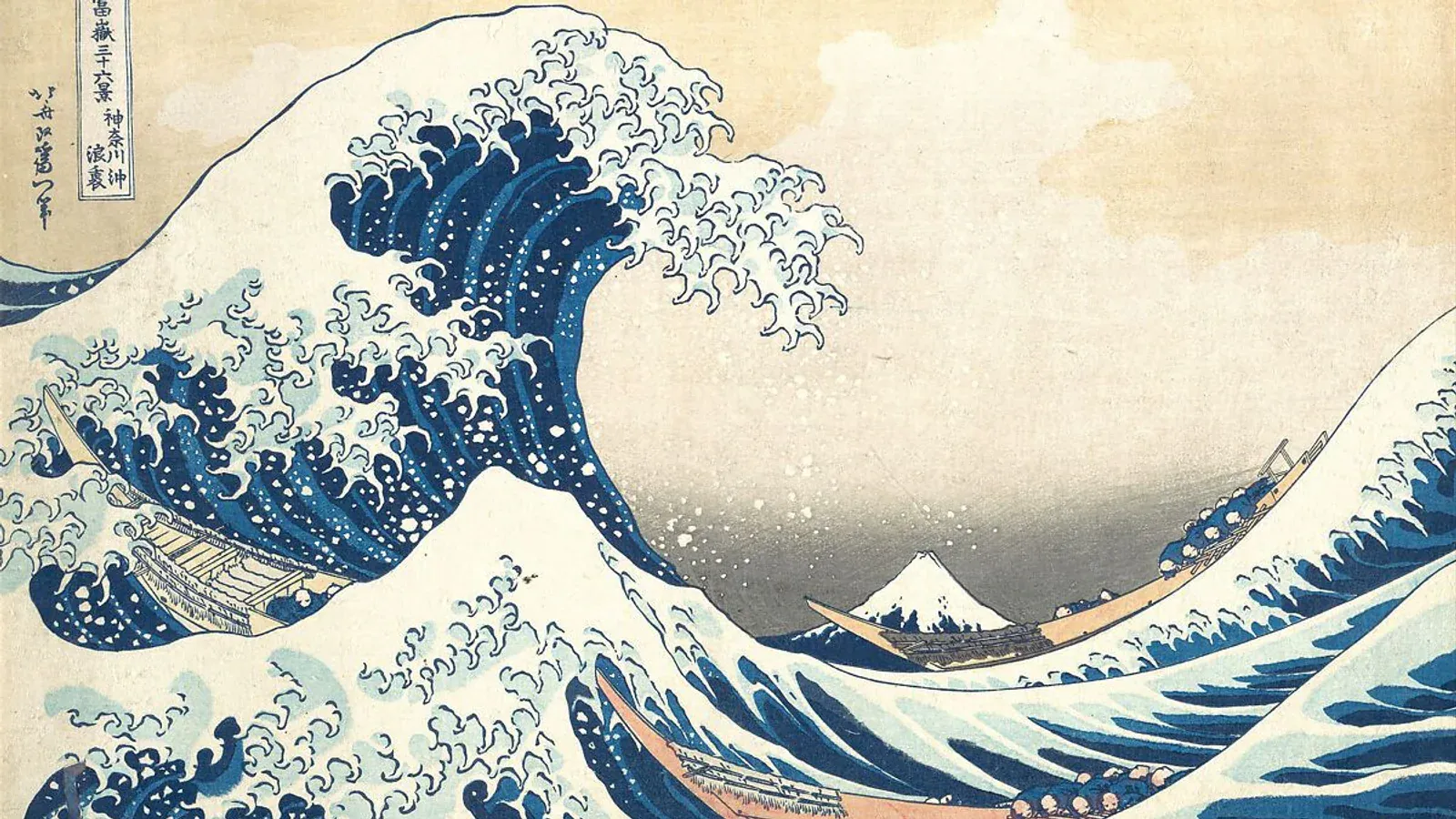
The Great Wave off Kanagawa is not a painting because its lines and colours were not brushed directly onto the final sheet. It is a polychrome woodblock print: the image was assembled by pressing the same paper against several carved wooden blocks, each prepared to transfer particular outlines or areas of colour.
“The Great Wave” is not its full title
The familiar name is a convenient abbreviation. The Japanese title, Kanagawa oki nami ura, is generally translated as Under the Wave off Kanagawa. It belongs to Katsushika Hokusai’s series Thirty-six Views of Mount Fuji, produced during Japan’s Edo period.
Catalogues differ slightly over the date. The Metropolitan Museum of Art dates its impression to about 1830–32, while the British Museum considers late 1831 probable. Describing the design as dating from around 1831 therefore reflects the remaining uncertainty.
The complete title also reminds us that the wave was not conceived in isolation. Mount Fuji, tiny but unmistakable beneath the water’s curve, connects the image to the rest of the series. Hokusai makes Japan’s highest mountain appear distant and small while the unstable sea fills the foreground.
A painting and a print are made differently
In a painting, an artist applies paint or ink directly to a surface. Each brushstroke becomes part of that object, and the result is generally unique unless somebody subsequently copies it.
In a woodblock print, the wood serves as a printing matrix. The areas intended to leave a mark remain raised, while the surrounding material is carved away. Ink or pigment is placed on the raised surface and transferred to paper.
The museum sheet therefore did not receive its lines directly from Hokusai’s hand. It received them from wooden blocks carved according to his design.
That does not make the result a mere copy. In printmaking, “print” does not mean a modern poster, photocopy or digital reproduction. A nineteenth-century impression pulled from the blocks made for the edition is an original example of the work.
Building the image one layer at a time
The Great Wave belongs to the ukiyo-e tradition, which developed a remarkably precise method of colour printing. The Victoria and Albert Museum describes a production team of four specialists: publisher, designer, block cutter and printer.
Hokusai first prepared a detailed design on paper. This was transferred to a block, normally made from hard cherry wood capable of holding exceptionally fine lines.
A specialist cutter removed the surrounding wood to leave the outlines standing in relief. Proofs taken from this key block then guided the preparation of additional blocks for the different areas of colour.
The printer brushed pigment onto a block, positioned the paper over it and rubbed the back of the sheet with a pad called a baren. The operation was repeated with the other blocks. The finished picture emerged gradually, one layer after another.
Registration marks ensured that the sky, boats, foam and Mount Fuji aligned throughout the process. The printer had to return the sheet to exactly the same position for every colour. A small error could create doubled outlines or visibly displaced areas.
Hokusai designed it, but he did not make it alone
We call the image “a work by Hokusai” because he conceived the composition and supplied the design. Yet the finished print was a collective achievement.
The publisher Nishimuraya Yohachi financed and issued the series. Cutters translated Hokusai’s brush lines into wooden relief, preserving details as delicate as the claw-like tips of the spray. Printers controlled the pigment, moisture, pressure and alignment of each layer.
The artisans who cut and printed The Great Wave have not been identified by name. Scientific research by The Metropolitan Museum of Art, however, demonstrates how directly their technical choices contributed to the image’s intensity and depth.
Hokusai’s signature identifies the designer, but it does not tell the complete story of the object’s manufacture.
The blue was transferred from wood
One of the series’ defining innovations was its prominent use of Prussian blue, a synthetic European pigment that had recently become more widely available to Japanese publishers.
Analysis of The Met’s impression found that the printers combined Prussian blue with indigo and overprinted certain areas. Parts of the wave’s dark interior received more than one layer. This produced visual depth while preserving the brilliance of the blue.
Pressure left a physical trace as well. Rubbing the paper against a block pushed it slightly around the carved relief. Where a passage was printed twice, this indentation could become more pronounced. The sheet is therefore not perfectly featureless: microscopic variations record its contact with the blocks.
This is fundamentally different from filling in a completed drawing with a brush. Form, colour and even some of the surface texture were created through printing.
There is more than one original Great Wave
A painting such as the Mona Lisa is a single object. The Great Wave has a different kind of originality because many sheets could be printed from the same blocks.
Each sheet is called an impression. The Met, the British Museum and the Victoria and Albert Museum hold different impressions of the design. They do not possess three identical paintings or ordinary photographic copies. They hold separate original examples from the woodblock edition.
Those impressions are not perfectly identical. Pigment strength and printing pressure could vary. Repeated use gradually wore the blocks, owners sometimes trimmed the paper, and exposure to light altered some colours. Sharp outlines and visible woodgrain may help specialists identify early impressions.
Two authentic Great Waves can therefore differ in their skies, outlines, blue saturation and paper margins. The design is shared, but every surviving sheet has its own material history.
Reproducible art and a commercial product
Ukiyo-e prints were made to circulate. Unlike a painting commissioned for a temple or a wealthy household, they could be produced in considerable numbers and sold to a broad urban audience.
Reproducibility did not eliminate craftsmanship. Cutting minute lines, preparing pigments and registering multiple blocks required extensive training. The technology could multiply the design, but every sheet still had to be printed by hand.
The Great Wave consequently united two qualities that modern viewers sometimes separate: it was an ambitious work of art and a commercial publishing venture.
The distinction also explains why ownership of a surviving impression is not equivalent to owning Hokusai’s preparatory drawing. The finished work was conceived as an edition, not as one unique painted sheet.
A small object with an enormous reputation
Constant enlargement on posters and screens can make The Great Wave feel monumental. The Met’s impression actually measures only about 26 by 38 centimetres—closer to a large sheet of paper than a vast museum canvas.
Its power comes from its composition. The wave’s curve encloses the scene, its spray stretches into finger-like forms and the boats repeat the motion of the water. In the distance, the stable profile of Mount Fuji contrasts with a foreground that seems about to collapse.
Calling the image a painting does not make it less beautiful, but it conceals its most revealing material feature. The Great Wave is a drawing converted into carved wood and reconstructed on paper through successive acts of hand printing. Seeing it this way reveals not only Hokusai’s design, but also the exceptional cutting, colour control and collective precision that made the image possible.