Natural ultramarine was expensive because it combined three costs: scarce raw material brought to Europe from distant parts of Central Asia, long trading routes, and a laborious refining process that yielded only a limited amount of the finest blue. It was not simply ground lapis lazuli. It was the purest blue fraction of a complex rock, extracted through days or weeks of skilled work.
Lapis lazuli was not the finished pigment
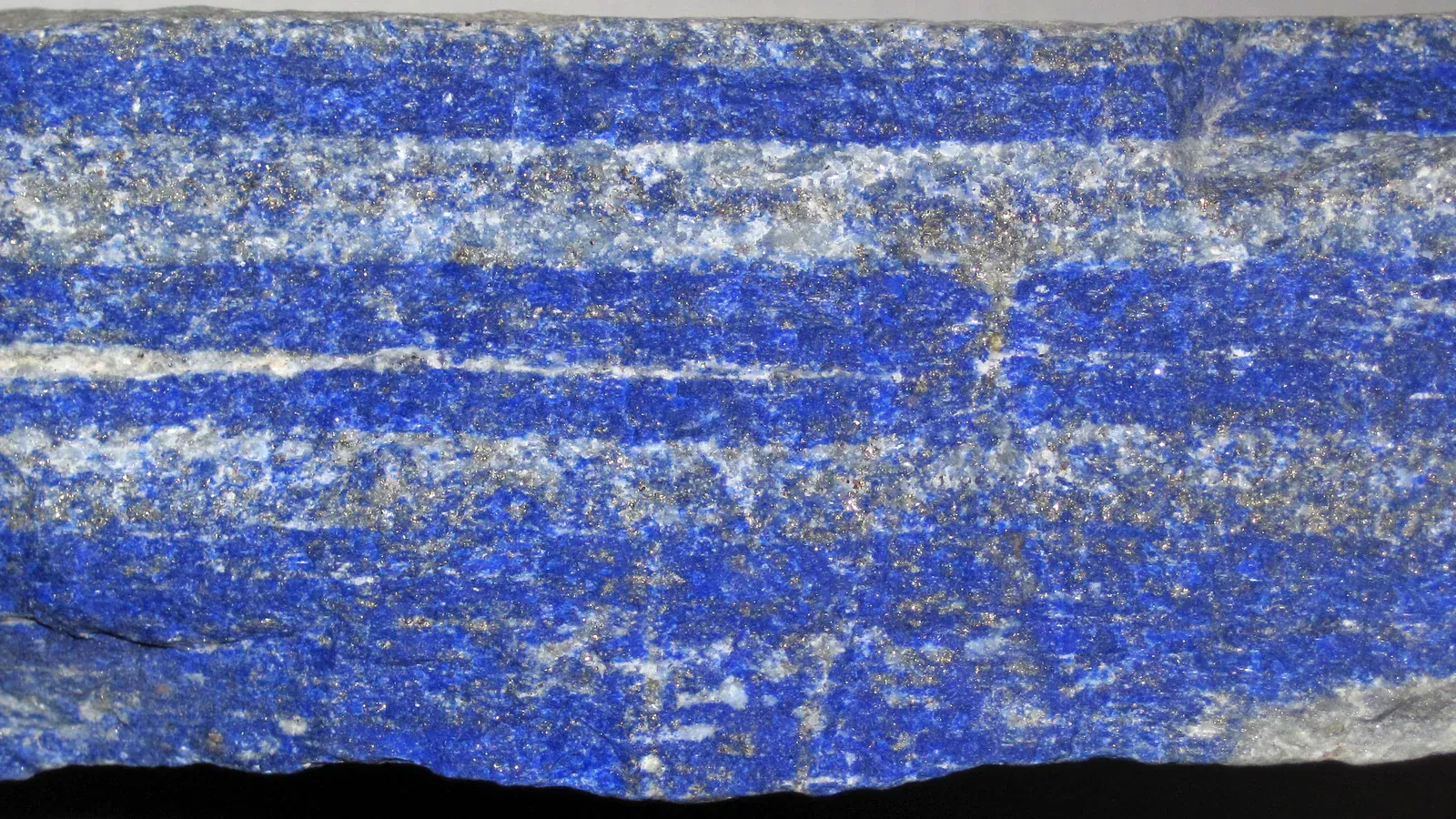
Natural ultramarine comes from lapis lazuli, an ornamental rock whose blue colour is chiefly produced by the mineral lazurite. Yet lapis is not uniformly blue. It commonly contains white calcite, golden pyrite and other minerals that can dull, grey or otherwise compromise a paint layer.
Grinding the stone alone was therefore not enough to make premium ultramarine. The Getty Research Institute defines the pigment as the ground and separated blue particles of lazurite from lapis lazuli. Its reference entry describes it as the most expensive pigment in Western medieval and Renaissance painting and manuscript illumination, often reserved for the Virgin Mary or another prestigious figure.
That distinction matters. Lapis lazuli was a valuable stone; ultramarine was a refined pigment obtained from it. Its price depended on the quality of the original material and on how effectively its blue mineral could be isolated.
A blue imported across continents
For much of the history of European painting, high-quality lapis lazuli was associated above all with Badakhshan in present-day Afghanistan, particularly the Sar-e Sang region. From there, the mineral moved through complex networks of trade into Persia, the Mediterranean and Europe.
The journey was not merely symbolic. “Ultramarine” evokes a material arriving from beyond the sea: for European buyers, this was a blue shaped by distant mines, overland routes, maritime trade and successive resellers. Each stage added cost, uncertainty and delay.
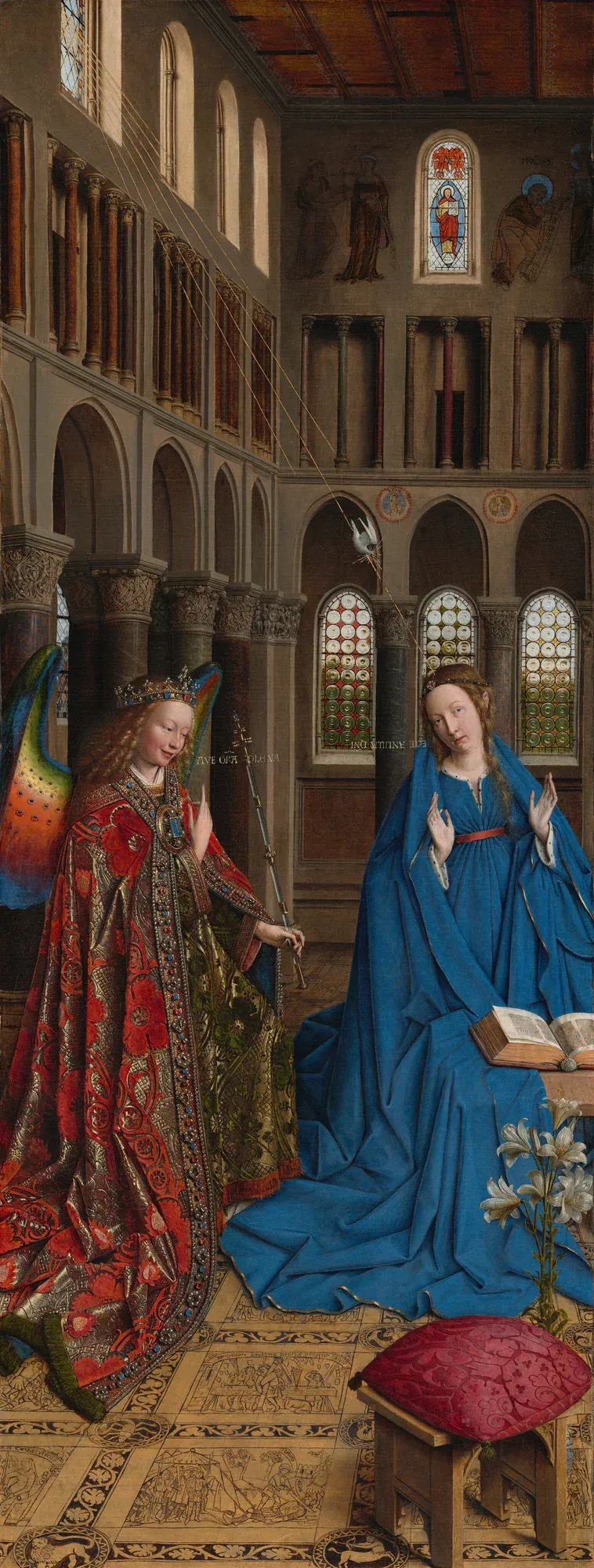
There was no single fixed comparison between ultramarine and gold. Prices depended on period, place, grade and availability. Still, historical evidence shows that in some European markets ultramarine could equal or exceed gold by weight. Discussing Jan van Eyck’s Annunciation, the National Gallery of Art notes that imported ultramarine was more expensive by weight than gold. Its account of the painting links Mary’s azure garment to the extraordinary luxury of the pigment.
The expensive step was extracting lazurite
The best-known historical process is called pastello extraction. After choosing and grinding the lapis, makers combined the powder with resin, beeswax and oil to form a dense paste. After resting, the paste was kneaded and washed in a mild alkaline solution.
This acted as a selective separation process. Fine particles of blue lazurite escaped into the liquid while many impurities remained trapped in the waxy mass. The blue suspension was then collected, filtered and dried.
Researchers from the University of Amsterdam and the Rijksmuseum have recreated this method from historical recipes. Their work shows that more than half of a lapis lazuli sample may consist of grey, yellow and white minerals, and that isolating the blue required patient, low-yield work. Their research on ultramarine preparation describes the resin, wax and oil mixture, followed by repeated washing that released the blue pigment.
The first extraction generally produced the deepest and most luminous blue, making it the most valuable grade. Later washes yielded less saturated material. The final, translucent grey-blue fraction could be sold as a lower-quality product known as ultramarine ash.
Valuable because it was visually powerful
Ultramarine was prized for more than scarcity. Its intense blue, slight transparency and luminosity made it especially effective in thin paint layers and glazes. In religious pictures, that visual effect could reinforce the symbolic importance of an image while turning colour itself into evidence of devotion and resources.
The Virgin Mary’s mantle became one of ultramarine’s most recognisable uses. This was not an absolute rule, and ultramarine was also used for skies, textiles, landscapes and other important figures. But placing it on Mary’s garment brought two forms of value together: the blue distinguished her visually, while the expense demonstrated the importance of the commission.
Artists could preserve the finest grade for small, highly visible passages and economise elsewhere. They could also use alternatives such as azurite, which was often more affordable. The economics of a painting depended not only on the size of a blue area, but on which blue was chosen, how pure it was and where it appeared within the paint layers.
Chemistry reveals why the yield was so low
Modern analysis helps explain the expense. A recent study of Egyptian blue and ultramarine reports that lazurite may account for only about 20 to 40 percent of the lapis lazuli used to prepare the pigment. Extraction could involve many washes, and the earliest fractions were the most desirable. The ChemTexts article describes the separation as long and complex, as well as the vast price difference that later emerged between natural and artificial ultramarine.
This changes the familiar story. Ultramarine was not expensive because someone arbitrarily assigned a high price to blue. It was expensive because transforming a mixed rock into a brilliant powder required select raw material, specialised knowledge and sustained labour, with limited output.
How ultramarine lost its monopoly
Natural ultramarine’s prestige began to shift when cheaper synthetic blues became available. Prussian blue, discovered in the early eighteenth century, was already an important alternative. Then, in the late 1820s, synthetic ultramarine made it possible to reproduce a pigment chemically close to natural lazurite without relying on Badakhshan’s lapis mines.
The National Gallery of Art dates the artificial production of ultramarine to around 1830 and notes that it soon displaced the more expensive natural material in artists’ palettes. Its technical discussion of pigments makes an important distinction: ultramarine in modern paint tubes is usually synthetic; the historically costly material was natural ultramarine.
Blue did not become less beautiful when it became less rare. What changed was its economics. For centuries, a brushstroke of ultramarine condensed a distant geography, an international trade network and a demanding process of mineral separation. That combination—not colour alone—made it one of art history’s most expensive pigments.