Roman concrete can last for millennia because its mixture of lime, volcanic material, water and stone aggregate produces remarkably stable mineral binders. Some formulations may also seal small cracks when exposed to water. There is no single secret ingredient, however: local recipes, mixing methods, environmental conditions, structural design and the survival of only certain buildings all contributed.
It was not the same concrete used today
Modern concrete commonly combines Portland cement, water, sand and gravel. Producing the cement requires heating limestone and other minerals to very high temperatures to make clinker, which is then ground. Many structures also contain reinforcing steel.
Roman concrete, or opus caementicium, was different. Its mortar combined lime with sand or a pozzolan: volcanic ash, crushed volcanic rock or another silica- and aluminium-rich material capable of reacting chemically. Builders added pieces of stone, brick or pottery known as caementa.
The word caementa eventually gave rise to “cement”, although the Romans used it chiefly for the solid fragments rather than a powdered binder like modern cement.
Nor did a single standard recipe exist across the empire. Builders adapted their materials to local resources and the intended structure. A wall in Rome, a cistern in North Africa and a breakwater on the Italian coast could contain very different mixtures.
Pozzolanic reactions create a stable binder
When lime, water and reactive volcanic ash are combined, they undergo a pozzolanic reaction. Silica and aluminium from the volcanic material react with calcium compounds to form cementing products that bind the aggregate together.
These products include calcium-aluminium-silicate-hydrate phases, often abbreviated to C-A-S-H. They fill spaces and produce a cohesive matrix around fragments of stone and brick.
Mineral development does not necessarily end within days of construction. The binder can continue evolving over years or even centuries. Research on Roman architectural mortar found stable minerals reinforcing interfacial areas and hindering the propagation of microcracks.
The material did not always provide the greatest possible initial strength. Its advantage may instead have been a slow chemical evolution combined with strong resistance to long-term deterioration.
Lime clasts may help repair cracks
Many Roman samples contain small, calcium-rich white inclusions known as lime clasts. For years, researchers treated them as evidence of poor raw materials or careless mixing.
A study published in 2023 examined concrete from Privernum, an ancient town southeast of Rome, and proposed a different explanation. The researchers found evidence that builders had incorporated quicklime directly, either alongside or instead of lime that had already been slaked with water.
Adding water to quicklime triggers a strongly heat-producing reaction. This hot-mixing process can create compounds and internal structures that would not form when using slaked lime paste alone.
According to the study in Science Advances, the resulting clasts possess a brittle and reactive architecture. A developing crack can preferentially pass through one of these areas. If water enters, calcium dissolves and can recrystallise as calcium carbonate, filling the gap.
The researchers tested the mechanism by making Roman-inspired mixtures, deliberately cracking them and running water through the fractures. Quicklime-containing samples sealed themselves in about two weeks, whereas otherwise similar concrete without quicklime did not. MIT’s account of the experiment describes this as a spontaneous self-healing mechanism.
This does not prove that every Roman structure repairs itself in the same way. The evidence comes from particular sites and formulations, and researchers continue to debate how widespread hot mixing was and how much it contributed relative to other processes.
Marine concrete follows a different path
Roman harbour structures present an especially striking case. Some piers and breakwaters have spent roughly two thousand years submerged in, or repeatedly exposed to, waves and salt water—conditions that damage many present-day materials.
These structures used lime-and-volcanic-ash mortar with pieces of volcanic rock. Instead of merely eroding the concrete, seawater could enter its pores and sustain further chemical reactions.
A mineralogical study of Roman marine concrete identified the growth of phillipsite and aluminium-rich tobermorite in voids, pumice fragments and altered regions of the matrix. These minerals form interlocking structures that may strengthen the material and hinder fracture propagation.
This does not mean seawater improves all concrete. The result depends on a specific combination of volcanic ash, lime, aggregate, porosity and water chemistry. Marine salts can seriously damage modern concrete, particularly when they reach embedded steel reinforcement.
Carbon dioxide may contribute too
Research published in 2026 added another mechanism to the picture. A team studying concrete from a latrine at Hadrian’s Villa in Tivoli found calcium-carbonate networks produced through carbonation.
During carbonation, atmospheric carbon dioxide reacts slowly with calcium compounds. The resulting calcite can fill pores, voids and fine cracks, densifying parts of the material and restricting water infiltration.
The finding does not replace earlier explanations. Pozzolanic chemistry remains fundamental, while carbonation may represent an additional transformation developing over very long periods. The University of California, Berkeley notes that the result comes from one particular structure and needs to be investigated across other Roman sites.
Carbonation can be harmful in modern reinforced concrete because it reduces the alkalinity that protects steel against corrosion. Roman concrete usually contained no internal steel bars, so the same disadvantage did not apply in the same way.
Architecture helped it survive
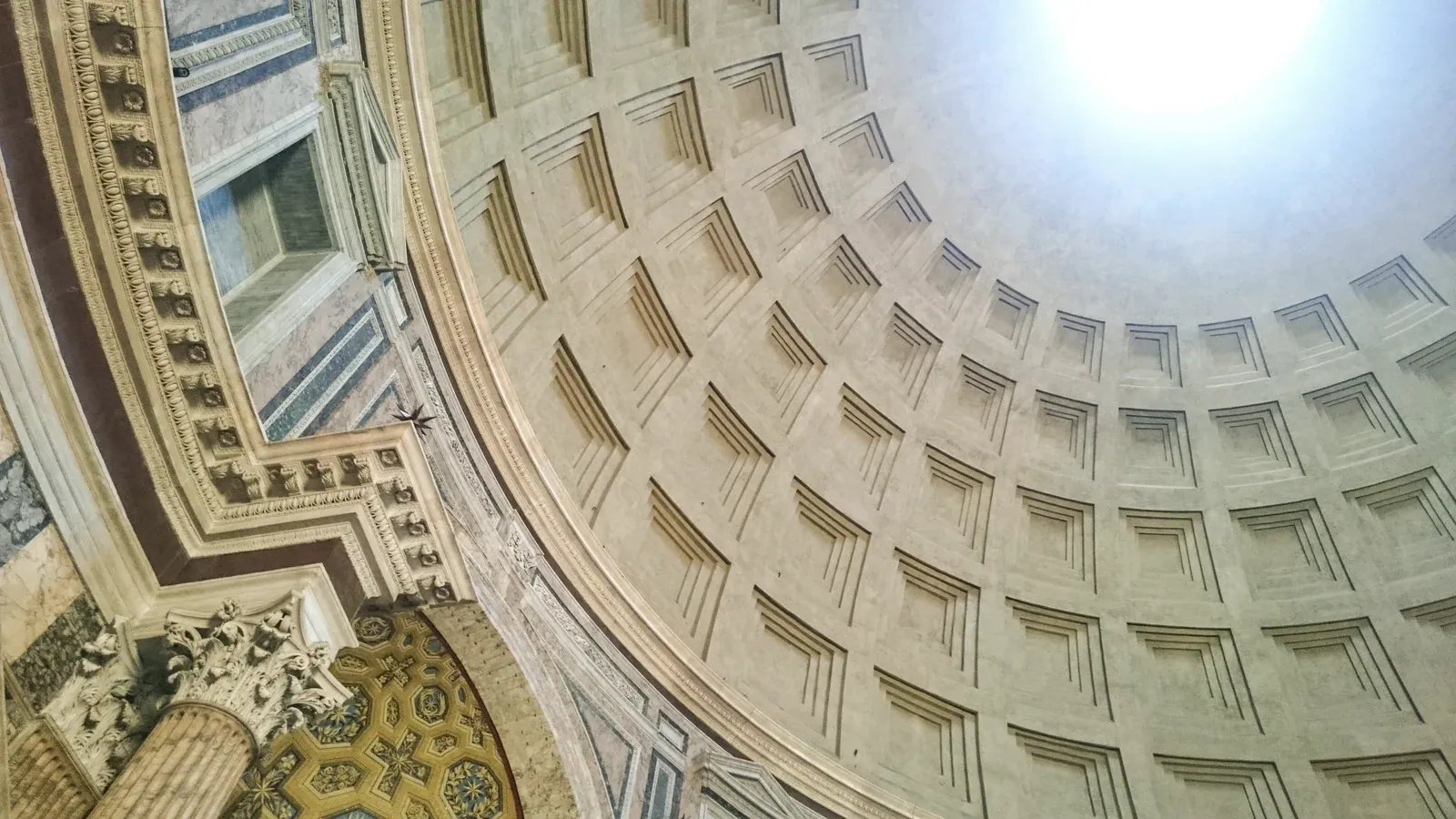
The Pantheon owes its longevity to more than the chemistry of its dome. Roman builders combined concrete with shapes that carried loads primarily through compression, a condition in which masonry and concrete perform particularly well.
Surviving structures are often thick and massive. In the Pantheon, the dome becomes thinner towards the oculus and incorporates progressively lighter aggregate in its upper zones. Coffers reduce weight while preserving the load-bearing geometry.
The absence of steel reinforcement also matters. Steel enables modern concrete to resist tension and makes far more slender bridges and buildings possible. If water and salts reach the bars, however, corrosion can make the steel expand and split the surrounding concrete from within. A massive unreinforced Roman dome does not experience that deterioration mechanism in the same form.
Not all Roman concrete survived
The surviving monuments create a powerful selection effect. We see the Pantheon, certain aqueducts and several harbour structures because they endured. Countless other buildings collapsed, were demolished, disappeared underground or were quarried for reusable materials.
The survivors may also have benefited from stable foundations, carefully selected ingredients, maintenance, repairs and favourable environments. Remaining intact for two thousand years does not prove that every Roman mixture was exceptionally durable.
Modern concrete is not simply inferior either. It can reach far greater strength in a short time, is manufactured under precise controls and enables structures that Roman engineers could not have built. It is often optimised for different priorities: rapid construction, slender forms, industrial consistency and collaboration with steel.
The useful Roman lesson is therefore not a universal recipe. It is the value of designing chemistry, aggregate, structural form and environment to work together over an entire service life. In the finest surviving examples, the concrete did not remain chemically frozen: it continued forming minerals, filling pores and responding to cracks long after its builders were gone.