The sky looks blue because molecules in the atmosphere scatter the shorter wavelengths of sunlight much more efficiently than the longer ones. Blue light is redirected in every direction and reaches our eyes from across the sky. The colour does not belong to the air itself: it emerges from the interaction between sunlight, the atmosphere and human vision.
The sky is not a blue surface
On a clear day, the sky can resemble a vast blue dome, but there is no coloured surface above us. Space beyond the atmosphere is essentially black. What we see is sunlight that has changed direction while travelling through the air.
Light arriving directly from the Sun follows a relatively well-defined path. Some of it, however, encounters molecules of nitrogen, oxygen and other atmospheric gases. These molecules redirect part of the light, allowing it to reach our eyes from areas of the sky far away from the Sun itself.
This is why the entire sky is bright during the day. Every direction in which we look contains molecules that can send a small fraction of sunlight towards us. Its colour depends on the fact that different wavelengths are not scattered equally.
Rayleigh scattering
Sunlight may look white, but it contains all the colours of the visible spectrum. Each colour corresponds to a range of wavelengths. Violet and blue have comparatively short wavelengths, while orange and red have longer ones.
Air molecules are far smaller than these wavelengths. Under these conditions, light is redirected mainly through Rayleigh scattering, whose intensity increases approximately in inverse proportion to the fourth power of wavelength. A modest decrease in wavelength therefore produces a large increase in scattering.
According to NASA’s explanation of Rayleigh scattering, light near 400 nanometres can be scattered around nine times more strongly than red light. Blue and violet are consequently redirected through the atmosphere far more efficiently than red.
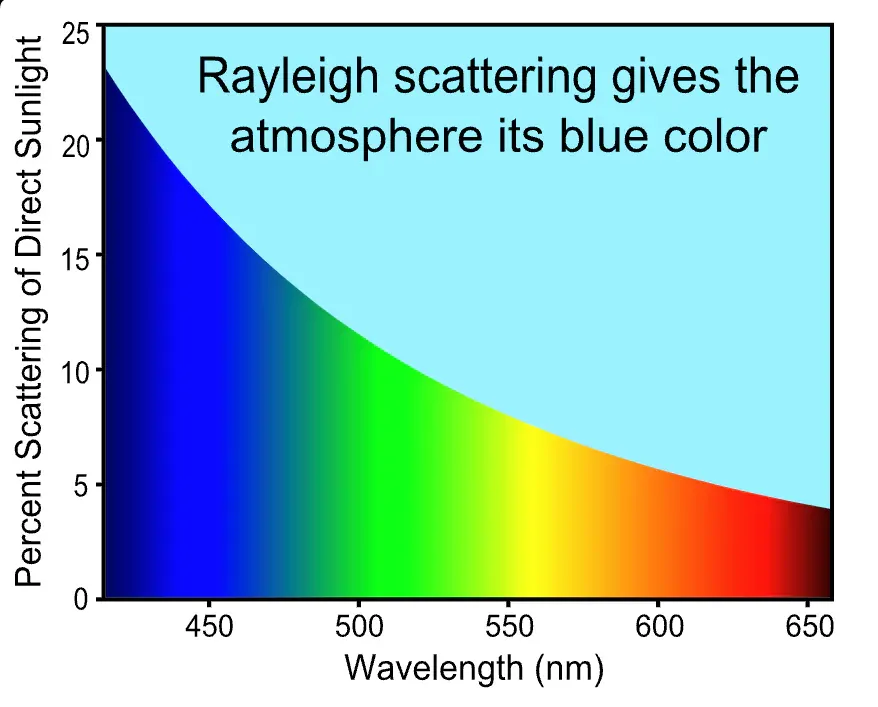
This difference turns the sky into a source of diffuse light. When we look away from the Sun, the radiation reaching our eyes contains a larger proportion of short wavelengths. Our brains perceive the resulting mixture as blue.
If violet is scattered more, why is the sky not violet?
The familiar explanation that blue light is scattered most strongly is a useful shortcut, but it is not entirely accurate. Violet has an even shorter visible wavelength and can be scattered more strongly than blue.
Several factors prevent the sky from looking violet. Sunlight does not deliver equal amounts of energy at every wavelength to Earth’s surface, and some violet and ultraviolet radiation is absorbed higher in the atmosphere. Human eyes are also considerably less sensitive to violet than to blue.
Skylight is not a single pure colour. It contains a mixture of blue, violet and other wavelengths. When the signals from our three types of cone cell are processed together, the usual result is a predominantly blue sensation. The joint NOAA and NASA educational explanation highlights both the partial absorption of violet and the limited sensitivity of our eyes to it.
Why the horizon looks paler
The blue is often deepest when we look high into a clear sky and less saturated near the horizon. In that low direction, light must travel through more atmosphere before reaching us.
During the longer journey, it may be scattered multiple times. It also encounters more aerosols, including dust, sea salt, smoke and tiny suspended droplets. These particles are larger than individual gas molecules and tend to scatter visible wavelengths more evenly.
The additional mixture of colours dilutes the blue. As a result, the horizon can appear whitish, hazy or grey-blue even on a sunny day.
Why sunsets are red
Blue skies and red sunsets are different outcomes of the same physics. When the Sun is high, its light follows a comparatively short route through the atmosphere. Near sunrise or sunset, it enters at a shallow angle and travels through much more air.
Along this extended route, much of the blue and violet is scattered out of the beam travelling directly from the Sun. The light that remains in the Sun’s direction is richer in yellow, orange and red wavelengths. Other parts of the sky can still appear blue or develop pink tones, depending on the geometry of the illumination.
Aerosols also affect the final colours. Dust, water droplets, pollution, smoke and volcanic particles can intensify, mute or shift them. This is why two sunsets viewed from the same location need not look alike. NOAA’s atmospheric explanation connects these changes to the longer path through air and the influence of molecules and aerosols.
Why clouds are white or grey
Cloud droplets and ice crystals are much larger than air molecules. They therefore scatter visible wavelengths more similarly. When comparable amounts of red, green and blue light reach our eyes together, we perceive white.
A thick cloud can look grey because less light travels through it to emerge from its base. Its droplets have not become grey; the amount and distribution of outgoing light have changed. NASA Earth Observatory describes the approximately non-selective scattering produced by cloud droplets.
A hidden property of the blue sky
Rayleigh scattering also partially polarises skylight. Polarisation describes the orientation in which the light’s electric field oscillates. The effect is usually strongest in parts of the sky located roughly 90 degrees away from the Sun.
Our eyes do not clearly reveal this structure, but it can be detected by rotating a pair of polarised sunglasses. Sections of the sky become lighter or darker as the filter turns. Some insects, including bees, can use the celestial polarisation pattern for navigation even when the Sun is partly hidden.
Without an atmosphere, the sky would be black
On the Moon, where there is no substantial atmosphere to scatter sunlight, the sky remains black even when the Sun is above the horizon. The ground can be brilliantly illuminated and cast sharp shadows while the background sky stays dark.
The same principle applies to photographs taken in space. The Sun is still producing light, but there are almost no nearby molecules to redirect that light towards the observer from every direction.
The blue sky is therefore not simply a colour possessed by Earth. It is the visible result of a precise physical sequence: white sunlight enters the atmosphere, shorter wavelengths are scattered especially strongly, and our visual system interprets the resulting mixture as blue.