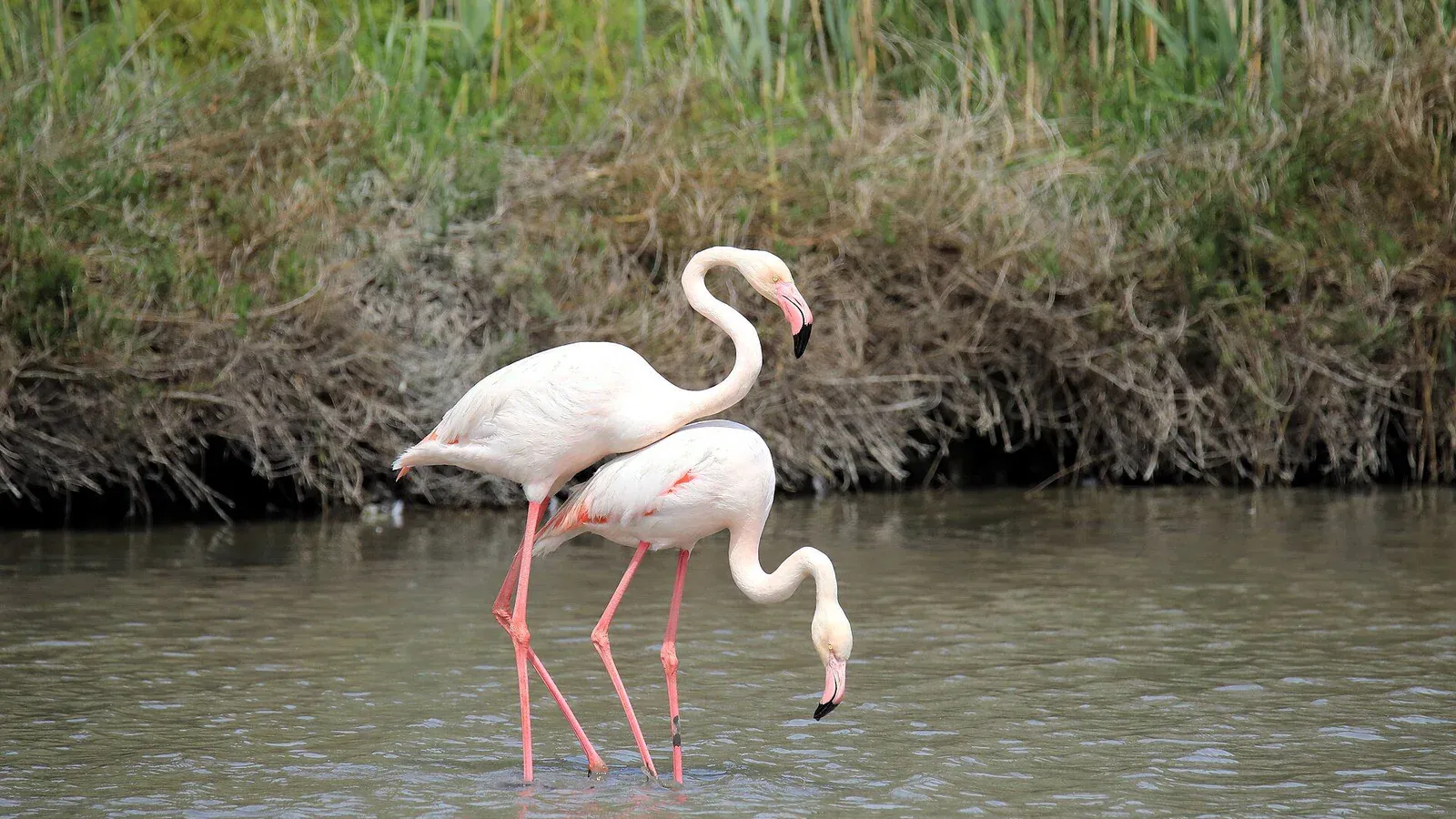
Flamingos are pink because their food supplies pigments called carotenoids. These compounds occur in algae, microorganisms and small crustaceans. After absorbing and processing them, a flamingo deposits the pigments in its skin and growing feathers, producing colours that range from pale pink to vivid red.
A flamingo therefore does not receive its final colour at birth. It has to acquire—and continue maintaining—it.
The colour begins with tiny organisms
Carotenoids are a family of natural pigments responsible for many yellow, orange and red colours. Plants, algae and some microorganisms can produce them, whereas animals generally obtain them through their diet.
In flamingo wetlands, algae and other microscopic organisms form the beginning of the pigment’s food chain. Small crustaceans eat these organisms and accumulate their carotenoids. Flamingos then filter algae, crustaceans, seeds, larvae and other food from the water.
This is the origin of the familiar claim that flamingos turn pink because they eat shrimp. The explanation is broadly correct but incomplete. Crustaceans can be an important source of pigment, but they are not the only one. Carotenoids may also come directly from algae and other components of a flamingo’s diet.
The Smithsonian’s National Zoo describes the essential process: flamingos consume carotenoid-rich algae and brine shrimp, then metabolise the pigments that colour their feathers.
From food to feathers
Eating a pigment-rich meal does not simply stain a bird from the outside. The carotenoids must first pass through the digestive system, be absorbed and travel through the body. A flamingo can retain some dietary pigments and chemically modify others before distributing them to different tissues.
Classic research comparing flamingo species identified several carotenoids in their blood and feathers. These include compounds such as canthaxanthin and astaxanthin, which are associated with reddish colours. Different species do not necessarily store the same mixture or proportions, as shown by the study Carotenoid selectivity in blood and feathers of lesser (African), Chilean and greater (European) flamingos.
Some of these pigments reach the follicles in which feathers develop. They become embedded as each feather grows. The main internal colouring process therefore does not work like dye soaking into an old feather: carotenoids are incorporated primarily into new feathers during the moult.
They also accumulate in bare tissues. Diet can consequently affect the colour of a flamingo’s legs, bill and exposed skin, although the exact pattern differs among species.
Chicks are not born pink
Flamingo chicks hatch with white or grey down. Their bills are comparatively straight, and they look very different from the long-billed, colourful adults around them. As they grow, they begin obtaining carotenoids and replace their juvenile covering with successive generations of feathers.
The adult appearance develops gradually, often over several years. The University of Michigan’s Animal Diversity Web account of the American flamingo describes how grey juvenile feathers are progressively replaced as the maturing bird incorporates dietary carotenoids into new growth.
This visible transition demonstrates that pink is not simply a permanent structural colour present from hatching.
Would a different diet make them lose their colour?
Yes, although the change would not happen overnight. If flamingos stop receiving sufficient carotenoids, the feathers produced later will be paler. Existing feathers may also fade through wear and exposure to light.
Zoos therefore provide carefully formulated food containing suitable carotenoid sources. This does not amount to artificially painting the birds. It gives them the pigments they would normally obtain through their natural food web. Without an adequate source, a flamingo can remain whitish or grey-pink even if it receives enough calories.
Wild flamingos are not all the same shade either. Colour varies with the amount and type of available pigment, the bird’s species and age, its reproductive stage and its ability to process particular carotenoids. A pale flamingo is not automatically a different species or an unhealthy individual.
Flamingos can apply their own “make-up”
There is another, less familiar part of the story. In at least the greater flamingo, colour does not come exclusively from pigments locked inside the feathers.
Birds have a uropygial gland, often called the preen gland, near the base of the tail. While preening, they collect its oily secretion with the bill and spread it over their plumage. In greater flamingos, this secretion contains carotenoids that make the feathers look redder—effectively acting as natural make-up.
An experiment published in Ecology and Evolution found that sun-exposed feathers became less red when no new secretion was applied. The findings suggest that flamingos need to renew this surface layer regularly if they are to preserve an intense colour.
The behaviour appears to become more frequent during periods of group courtship display. Colour is therefore more than a passive by-product of feeding: in some flamingos, it is also a visual signal that the bird actively maintains.
Pink does not have one simple meaning
A flamingo’s shade records part of its recent history: which pigments were available, how its body processed them, when its feathers grew and, in some species, how actively it has preened. But colour should not be treated as an infallible health gauge. Any comparison must account for species, age, habitat and reproductive stage.
The short answer remains that flamingos are pink because of carotenoids in their food. The fuller answer is a biological chain beginning with algae and other tiny organisms, continuing through the bird’s metabolism, becoming fixed in growing feathers and sometimes receiving a final cosmetic boost from the flamingo itself.