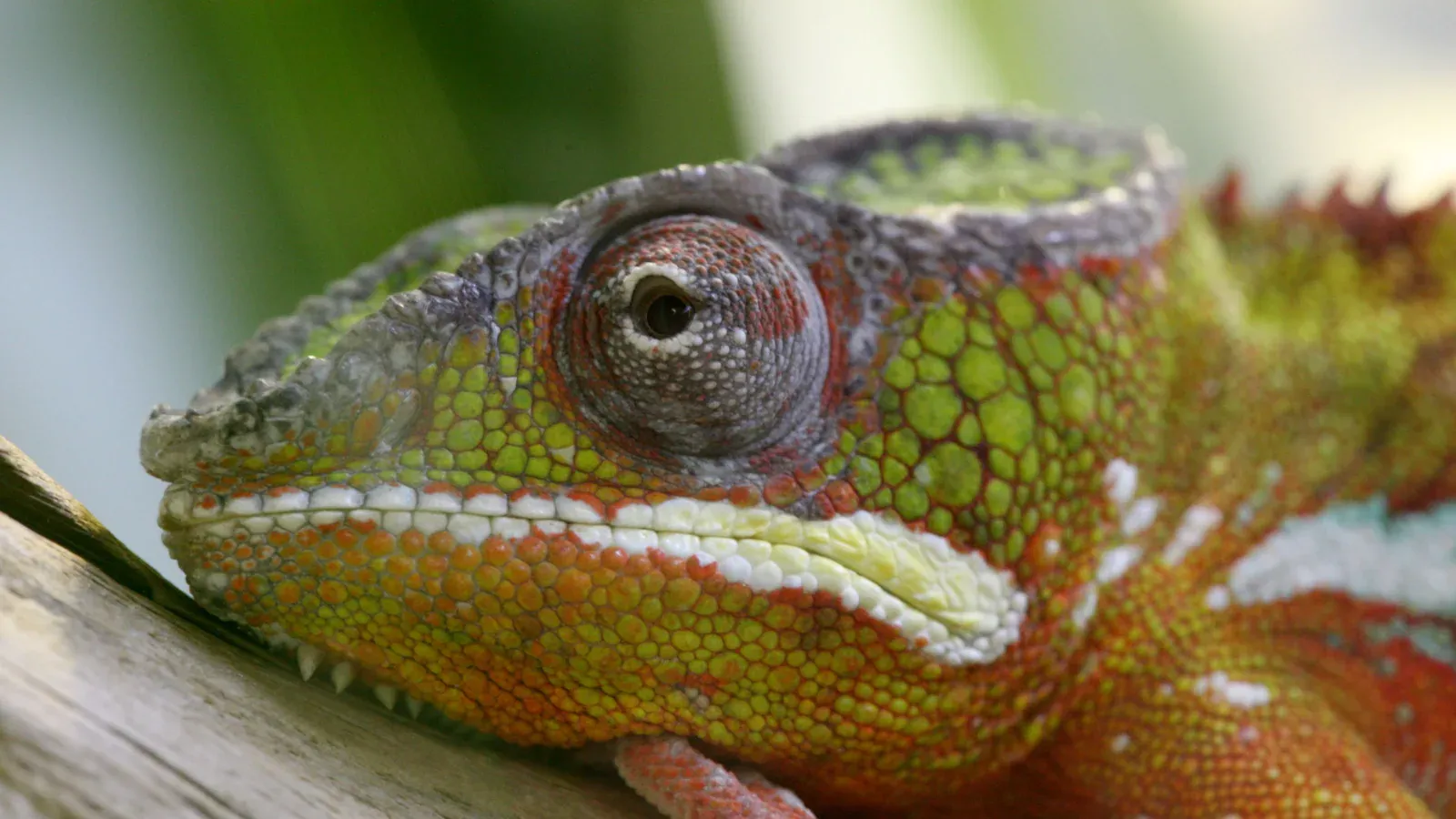
Chameleons change colour mainly to communicate with other chameleons, respond to stress and manage their interaction with light and heat. Camouflage can play a part too, but they cannot copy every background at will. The transformation comes from specialised skin cells that redistribute pigments or alter the way light is reflected.
In some species, a dramatic shift can take place within only a few minutes.
They do not behave like living screens
Popular culture often treats a chameleon like a display: put it on something red and it turns red; move it to a blue surface and it becomes blue. Its real ability is more restricted—and scientifically much more interesting.
Every species has a colour range constrained by its anatomy, pigments and microscopic skin structures. A chameleon cannot produce any imaginable hue or reproduce a complicated background pattern as though it had photographed its surroundings.
Its appearance does not come from a single layer either. Beneath the surface are several kinds of chromatophores, cells associated with animal colour. Some contain yellow or red pigments. Others contain melanin, which can darken or lighten areas of skin. Reflective cells called iridophores also create structural colours by controlling light.
The colour we see results from interactions between these layers. Blue light reflected by internal structures can, for example, pass through yellow pigment cells and contribute to a green appearance. This resembles colour mixing, although the physics is not the same as combining paints.
Tiny crystals control reflected light
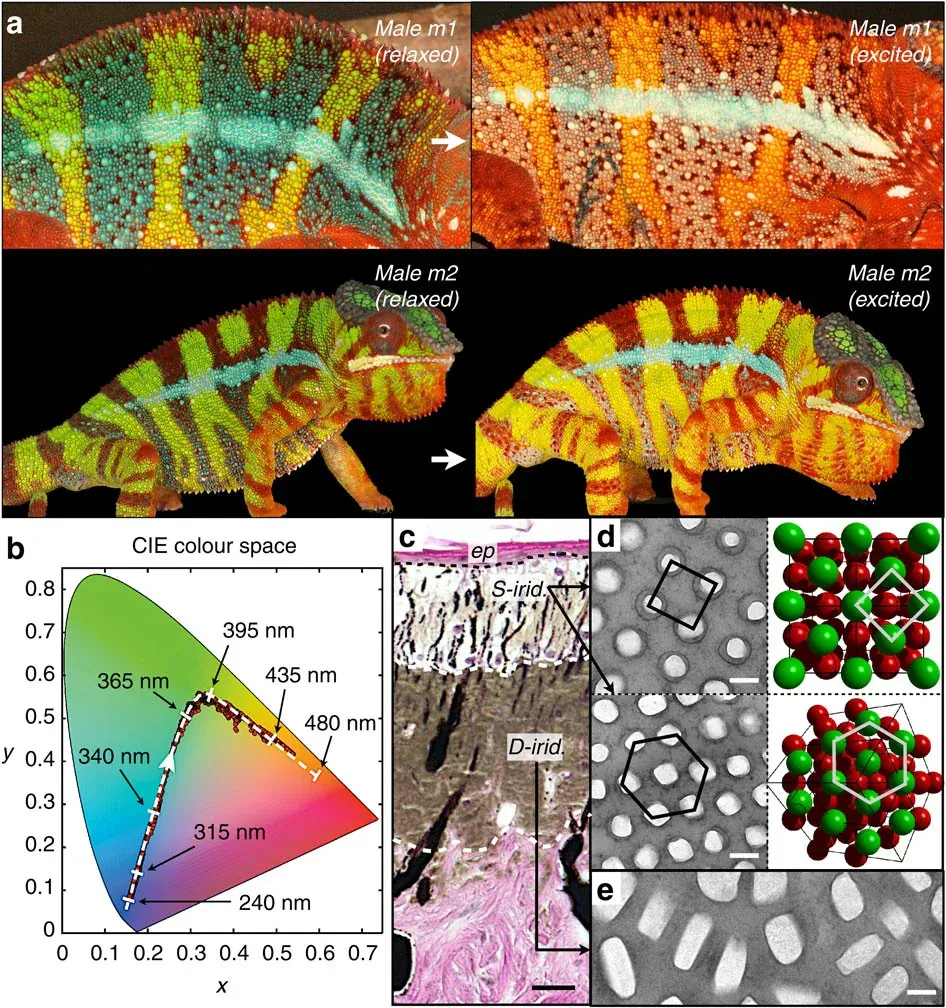
A landmark study published in Nature Communications examined the skin of the panther chameleon, Furcifer pardalis. Using microscopy, spectroscopy, video and optical modelling, the researchers identified two superimposed layers of iridophores containing transparent guanine nanocrystals.
The upper iridophores act as a photonic crystal: a microscopic structure that selectively reflects particular wavelengths of light.
When an adult male panther chameleon is relaxed, the nanocrystals sit relatively close together and preferentially reflect shorter, blue wavelengths. Combined with yellow pigments in other cells, this reflected light can help produce a green appearance.
When the animal becomes excited by a rival or a potential mate, the average spacing between the crystals increases. The structure begins reflecting longer wavelengths, allowing the skin to shift towards yellow, orange or reddish colours. In the study, the spacing between crystals was about 30% smaller in relaxed skin than in excited skin.
The crystals themselves do not grow. It is their spacing and arrangement that change, altering which part of the spectrum is reflected towards an observer.
Precisely how the chameleon controls the geometry of this crystal lattice remains unresolved. Neural or hormonal signals probably contribute, but researchers have not yet established the complete molecular chain.
The discovery should not be applied identically to every chameleon. The superficial iridophore layer investigated in the study is particularly well developed in adult male panther chameleons and is reduced in females and juveniles.
A conversation written across the skin
The most conspicuous changes often happen during social encounters. A male may intensify its colours while courting a female or confronting another male. A female may use colour to signal receptiveness or rejection. Darker patterns can also accompany stress, fear or submission.
Saying that colour simply reveals a chameleon’s “mood” is too vague. It is more accurate to describe it as a dynamic signal combining physiological state with context: threat, courtship, willingness to fight, retreat or stress.
Research on veiled chameleons found that separate body regions conveyed different information during male contests. Males with brighter side stripes were more likely to approach an opponent, while head brightness and the speed of head-colour change helped predict the winner. The findings, published in Biology Letters, show that chameleon colour is a multi-part signal rather than a simple on–off display.
Comparative research also suggests that social signalling helped drive the evolution of dramatic colour-change abilities in some lineages. A study in PLOS Biology found that species using more conspicuous social signals tended to have a greater capacity for colour change.
Colour can help manage temperature
Chameleons are ectotherms, relying heavily on external sources of heat. Altering skin brightness can help them manage that energy.
In general, a darker surface absorbs a greater proportion of incoming radiation, which may help an animal warm up. A lighter appearance can reflect more light and reduce absorption. The actual response depends on the species, habitat and other pressures acting at the same time.
Panther chameleon skin also contains a deeper iridophore layer with larger, less orderly crystals. These cells do not appear to produce the rapid visible shift in hue. Instead, they reflect a substantial amount of near-infrared radiation and may provide passive protection against intense sunlight. The University of Geneva described this deeper layer as a heat shield.
Thermoregulation and communication can pull colour in different directions. A chameleon that darkens to warm itself may become more visible, while a bright social display may expose it to predators. Its final appearance can therefore represent a compromise among competing needs.
Is camouflage a myth, then?
Not exactly. The myth is that a chameleon automatically and perfectly reproduces every surface. Its usual coloration may already conceal it among leaves, branches and shadows, while rapid change often serves communication or thermal control. Nevertheless, evidence shows that some species also adjust their appearance to improve camouflage.
In a 2025 experiment, researchers placed flap-necked chameleons, Chamaeleo dilepis, against standardised backgrounds. The animals darkened to become a closer match for black backgrounds and adjusted their hue in response to some colours, especially yellow. They did not reproduce the printed background patterns. The study in Biology Letters demonstrates genuine background matching, but also reveals its limits.
The most accurate answer therefore depends on the species and situation. Chameleons change colour through a sophisticated interaction between pigments and light-reflecting nanostructures. They use this ability chiefly as a visual language, also to manage radiation and temperature and, in certain contexts, to make themselves harder to detect.