Octopuses have three hearts because their circulation divides blood transport into two consecutive jobs. Two branchial hearts, one beside each gill, push oxygen-poor blood into the respiratory organs. A third, systemic heart then receives oxygenated blood from the gills and pumps it around the body.
These are not three identical hearts or spare organs waiting to take over. They are specialised pumps working within one circuit.
Three hearts, two jobs
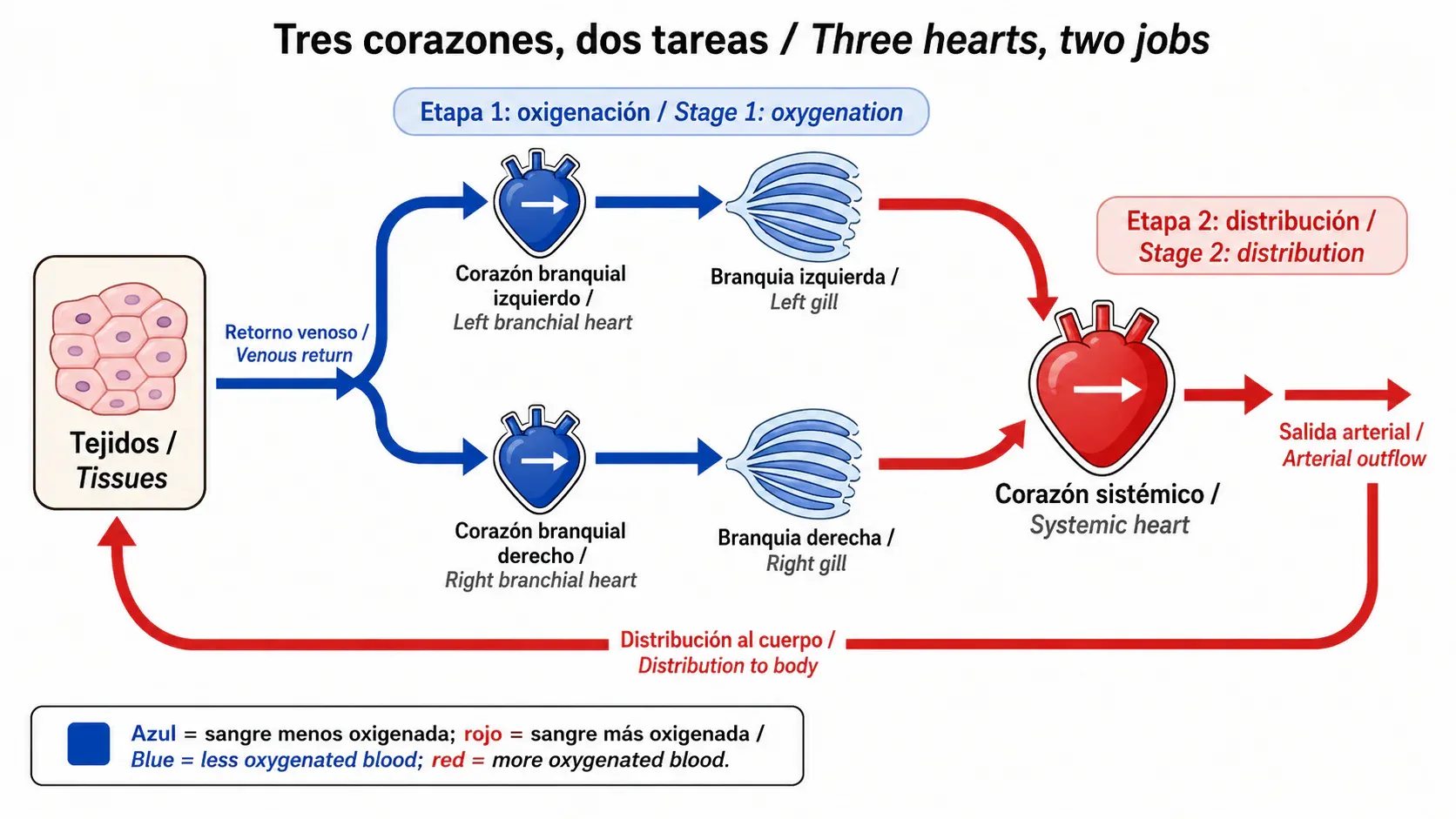
An octopus has a branchial heart at the base of each of its two gills. The pair receives blood returning from the tissues and produces the pressure needed to move it through the narrow vessels of the gills, where oxygen enters from the surrounding water.
Blood leaving both gills then reaches the systemic heart. This central pump supplies the head, mantle, arms and other organs. In simplified form, the journey is:
- Body tissues use oxygen and return oxygen-poor blood.
- The two branchial hearts pump that blood towards the gills.
- Gas exchange takes place across the gill surfaces.
- The systemic heart distributes the oxygenated blood throughout the body.
The anatomical account by Ángel Guerra in the Handbook of Pathogens and Diseases in Cephalopods describes the coordinated contraction of the two branchial hearts, followed by the systemic heart supplying the body.
Why place separate pumps beside the gills?
A gill is not an empty chamber through which blood moves freely. It contains extensively folded surfaces supplied by narrow vessels. This structure provides a large area for oxygen exchange, but it also creates resistance to blood flow.
The branchial hearts act as booster pumps positioned before this demanding section. They raise the pressure of returning venous blood and drive it through the two gills. Once the blood has crossed them, the systemic heart provides the pressure required for its journey around the body.
The functional reason for having three hearts is therefore not simply that an octopus has blue blood. The answer lies in the whole layout: two gills, a closed network of vessels and two stages of circulation that require active pumping. Classic research on octopus circulation describes the accessory gill pumps, relatively high systemic pressure and contractile vessels as parts of the same oxygen-delivery system.
An unusual mollusc circulation
Octopuses are molluscs, related to snails, clams and slugs, but their circulation differs significantly from that of most members of the group.
In many molluscs, circulatory fluid partly leaves the vessels and bathes the organs in open spaces. Octopuses and other coleoid cephalopods, including squid and cuttlefish, instead possess a closed circulatory system. Blood travels through arteries, veins and capillaries.
A closed system provides close control over pressure and the distribution of oxygen. That suits animals with large nervous systems, active muscles, complex movements and highly developed senses. The trade-off is that driving blood through an extensive vascular network requires effective pumps. The two branchial hearts and the systemic heart are elements of this specialised arrangement.
What does blue blood have to do with it?
Octopus blood transports oxygen using haemocyanin. This copper-containing protein takes on a bluish colour when oxygenated. Human haemoglobin contains iron instead, producing the familiar red colour of our blood.
Haemocyanin circulates dissolved in the plasma rather than packaged inside red blood cells. Its oxygen-binding behaviour also varies markedly with temperature, pH and species. The Smithsonian Ocean Portal explains both the origin of the blue colour and the division of labour between the branchial and systemic hearts.
It is sometimes claimed that octopuses have three hearts simply because haemocyanin is “inefficient”. That is too blunt an explanation. Oxygen-carrying capacity affects the demands placed on the circulation, but the three-heart arrangement must also be understood in relation to paired gills, vascular resistance and a closed circulatory system.
Do all three hearts beat in the same way?
Not quite. Although the hearts are coordinated, they differ in anatomy and function. The branchial hearts pump deoxygenated blood and have associated nerve centres. The systemic heart receives blood from the gills, fills and then drives it into the body.
Experiments involving freely moving octopuses found that the rhythm could continue even after certain connections with the central nervous system were severed. The study “Nervous Control of the Heartbeat in Octopus” argued that pacemakers in the branchial-heart and cardiac-ganglion complexes play an important part in regulating the rhythm.
The result is a coordinated system with a degree of local control. It does not mean that each heart is independent or that any one of them can perform the others’ jobs.
The advantage lies in divided labour
Hearing that an octopus has three hearts can suggest that it possesses three versions of a human heart. A better comparison is that our single, multi-chambered heart contains separate pumping sides for the lungs and the body. The octopus distributes related functions among physically separate organs.
Its branchial hearts increase pressure before blood enters the gills. The systemic heart restores pressure after gas exchange and supplies the tissues. The important adaptation is not having hearts to spare, but placing a pump at every stage where the circuit needs one.